
Columbus County Court Records After Arrest
The Columbus County custody report is unusually useful for court follow-up because many charge lines include docket number, court level, court date, court time, court location, attorney, bond amount, bond status, and charge status. After an arrest, the jail record may reflect an arresting agency charge or a holding reason. The court record shows what the judicial branch has opened, what the prosecutor pursues, what hearings are scheduled, and how the charge is later disposed.
Use Columbus County jail inmate records for the booking and custody side. Use court records after a jail arrest for the filed case, hearings, charge status, warrants, bond orders, dismissal, conviction, or expunction path. Booking photos are a separate issue handled on the Columbus County jail mugshots page.
Arrest to Court Record Path
The public pathway begins with arrest and booking. Under N.C. Gen. Stat. 15A-501, an arrested person must be taken before a judicial official without unnecessary delay. The judicial official addresses early release conditions. The custody report may then show the court level, next court date, and docket number once that data is available.
Felony matters may begin in District Court and later move to Superior Court. Prosecutorial District 15, led by District Attorney Jon David in the research, covers Bladen, Brunswick, and Columbus counties. The prosecutor can dismiss, amend, reduce, supersede, consolidate, or proceed on charges in ways that differ from the original jail report wording.
Text flow: Arrest -> booking -> first appearance -> docket number -> prosecutor review -> District or Superior Court case -> disposition or sentence.
Find Court Records After Arrest
The official online court channel is the North Carolina eCourts Portal. Public users can use Smart Search for case information, Search Hearings for court dates, Make Payments for eligible matters, and NC Judgment Search. The official Portal training page says Smart Search may expose case summary, register of actions, case information, party information, events, dispositions, hearings, and financial information when applicable.
- Copy the docket number exactly from the Columbus County custody report if one is listed.
- Open the eCourts Portal and use Smart Search by case number or defendant name.
- Use Columbus County or location filters when available to reduce name-match noise.
- Open the case details and compare charge status, hearing dates, and disposition against the jail report.
- Use Search Hearings when the immediate need is the next court date or courtroom.
The North Carolina eCourts Portal is the state system used for public case search.
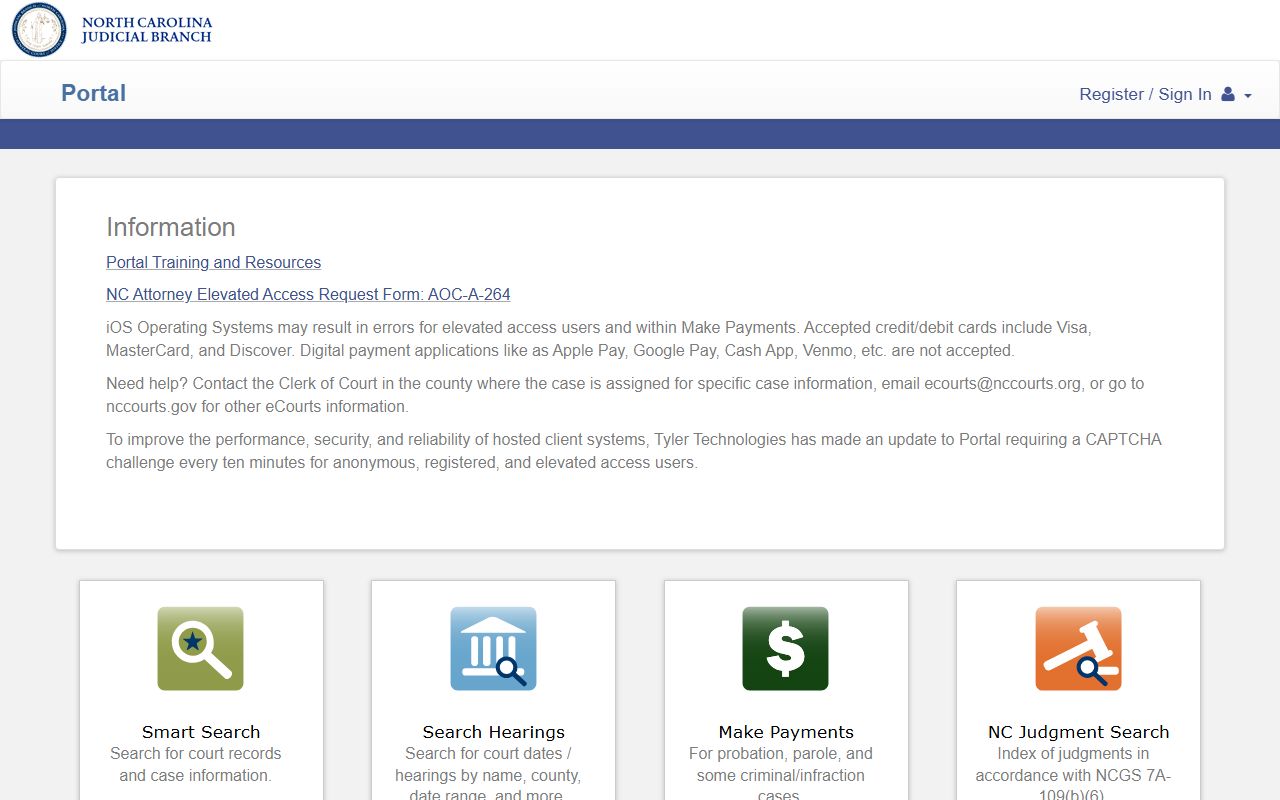
The portal search is the court-record step. It does not replace the sheriff's custody report for jail status.
Columbus County Court Search Fields
Portal training describes both Smart Search and Search Hearings. A docket number from the jail report is often the cleanest route because name searches can return unrelated cases. The research also notes the eCourts case-number pattern, and Columbus report docket numbers such as 26CR280250-230 fit the style of a court number that can be copied into the portal.
| Field Label | Type | Required | Notes |
|---|---|---|---|
| Smart Search | Text | Yes | Search by case number, party name, or business/name terms. |
| Location | Filter | Optional | Select Columbus County when the portal offers location filtering. |
| Party Name | Text | Optional | Wildcard rules may allow partial name searches. |
| Case Type | Filter | Optional | Criminal actions are an advanced filtering option. |
| Case Status | Filter | Optional | Narrows active or closed status where exposed. |
| Search Hearings | Text/filter | Optional | Search by case number, party, attorney, judicial officer, or courtroom. |
Charges Filed After Arrest
North Carolina criminal cases can move through different charging documents depending on the charge type and procedural stage. The jail report may show the arrest or custody charge, while the court record shows what the prosecutor or court has actually filed. That is why a court records after arrest search should compare the jail charge, docket number, and court status instead of treating the first booking label as the final case outcome.
| Document | Who Uses It | What It Means |
|---|---|---|
| Complaint or citation | Law enforcement or court process | Starts or supports a criminal matter, often for less complex charges. |
| Information | Prosecutor | Formal charging route used in eligible criminal matters. |
| Indictment | Grand jury / prosecutor | Common felony route before Superior Court prosecution. |
Columbus County Charge Status
The Columbus County jail report uses court-connected charge-status language. A charge status is not the same as a final judgment. A dismissed line may not end all other charges, and a no-bond line may keep a person in custody even when another line shows a dollar amount. Court records after a jail arrest should be checked line by line.
| Status | Plain Meaning |
|---|---|
| Awaiting Trial | The charge or case remains pending trial or resolution. |
| Awaiting Sentencing By Courts | The matter has moved beyond guilt or disposition, but sentencing is still pending. |
| Case Dismissed By Courts | That charge line was dismissed, but other lines may remain active. |
| Reduced or amended | The prosecutor or court changed the charge from the original form. |
| Conviction | A plea, verdict, or adjudication found guilt. It is not the same as arrest. |
Bond After Columbus County Arrest
North Carolina release conditions are governed by G.S. 15A-534. The Columbus County custody report shows Bond Amt, Bond Status, and Bond Type by charge line. Observed values include secured bond, no bond, active bond, and Included in Oth. Court bailiff deputies also prepare release orders and bond sheets according to the sheriff's courts division page.
| Bond Term | Meaning in Columbus County Records |
|---|---|
| Secured Bond | Money, security, or bondsman-style posting is usually required unless changed by court. |
| No Bond | Money alone will not release the person under that order or hold. |
| Included in Oth | The bond for that charge appears grouped with another line, so confirm before adding amounts. |
| Active Bond | The bond order appears active as of the report date. |
Warrants and Court Records
No official public Columbus County warrant-search form was located. The sheriff app advertises Most Wanted, but the research did not verify a warrant database. A warrant that leads to arrest may appear in the jail report through charges such as failure to appear, probation violation, outside-county warrants, or other hold language. For court-related failure-to-appear matters, contact the Clerk of Superior Court at 910-641-4400 or search eCourts for the case and hearing history.
Charges vs Convictions
An arrest and a charge are accusations or custody events. A conviction is a court outcome after a plea, verdict, or adjudication. Columbus County court records after a jail arrest should be read with that distinction in mind, especially when the jail report still shows Awaiting Trial or when eCourts later shows a dismissal or amended charge.
| Charge | Conviction | |
|---|---|---|
| Stage | Accusation or filed case count | Final guilt outcome by plea, verdict, or adjudication |
| Where Seen | Jail report and court case | Court disposition and sentence fields |
| What It Proves | Case was alleged or pending | Case resulted in guilt finding |
Sealed and Expunged Records
North Carolina expunction rules, including G.S. 15A-145.5, may affect eligible criminal records. Expunction is a court process. It is not the same as asking the jail to change a current custody report, and it does not automatically erase every third-party copy. A person dealing with dismissal, acquittal, or eligible older convictions should use the court process and verify what agencies receive the order.
| Sealed | Expunged | |
|---|---|---|
| Public view | Hidden or restricted from ordinary public access. | Removed or treated under the expunction order. |
| Agency access | May remain available to certain authorized users. | Depends on North Carolina law and order terms. |
| Route | Court order or restricted-access rule. | Petition and court order for eligible records. |
Copies From Columbus County Courts
The North Carolina Judicial Branch court-records page says criminal cases can be accessed at public self-service terminals in a clerk's office and searched by defendant name, case number, or victim/witness name. Paper files may be available at the clerk's office in the county where the case is located, with copy fees handled by the court. Background checks should use the county clerk's office rather than relying on portal snapshots alone.
Important: Court lookups are public-record checks, not FCRA consumer reports for employment, housing, credit, or insurance screening.